

What has been your favorite mind-boggling decision of Manchester United's lost era? Mine was when they hired Ralf Rangnick to establish modern pressing-and-possession principles for half a season ... three months after signing Cristiano Ronaldo, the most anti-pressing-and-possession star of the modern era. Shockingly, it wasted everyone's time (though Rangnick still averaged more points per game than Ruben Amorim).
Given everything we've learned about running a properly functional soccer club in the 2020s, it's nice to have a strong "Don't be like [insert club name here]" at which to point.
You're supposed to use your front office to establish the direction and identity of the club, then hire the coach to follow that identity; the era of the "Great Man" manager is over. But Manchester United, the club that owes its modern success (and valuation) to the greatest Great Man manager of the past 50 years (Sir Alex Ferguson), can't help but search for the next Fergie at all times.
You aren't supposed to constantly hire the stylistic opposite of your ex, especially if you're giving the new hire too much power over player acquisitions: If you do, you'll end up with a squad of mishmashed parts acquired for all sorts of different purposes. But that seems to be all Manchester United know to do. They lurched from the defense-and-counter David Moyes to the ultracautious, all-possession Louis van Gaal, back to the mostly negative Jose Mourinho, then to the positive (and probably too adaptive) Ole Gunnar Solskjaer.
- Ogden: Man United have finally hired a proper manager
- Dawson: How Carrick won the Man United job and lost it again
- Carlisle: Pochettino leaves USMNT with job half-finished
After briefly failing with Rangnick's gegenpressing, they asked Erik ten Hag to find some middle ground between possession and defense. When this shockingly proved difficult, they asked Ruben Amorim, with his rigid 3-5-2 formation, to do the same. Just as he was establishing strong underlying numbers and advanced stats -- another aspect that successful modern clubs long ago began to rely on, including a Brentford team that spends infinitely less than United and earned more points over the past 2½ seasons -- Amorim was pushed out the door in favor of another favorite son, Michael Carrick.
Now Carrick's gone, too.
The tenures are getting shorter and shorter, the wins fewer and further between.
Throw in Rangnick's unhappy time (1.48 PPG) as half-season interim between Solskjaer and ten Hag, and three of the four shortest and least successful United tenures have come in the past four hires (and five years). Shockingly, returns diminish when you never establish a plan, and the initial rumored candidates list for replacing Carrick -- the passion-and-pressing Mauricio Pochettino, the far more defensive Antonio Conte and Eddie Howe, the almost van Gaal-like Julian Nagelsmann -- didn't exactly hint at a clear plan this time around, either.
Instead, it appeared to be another search for a Great Man who can't possibly fulfill expectations, and that will evidently be Mauricio Pochettino.
He makes as much sense as anyone, and Pochettino's teams usually play a fan-friendly, hard-charging style. But he will inherit both a team that has won only one of its past 11 matches to sit in 18th place in the Premier League and a squad that was compiled in the most haphazard, stylistically inconsistent manner imaginable.
Let's look into exactly what has gone wrong and what Pochettino will be asked to fix.
What's gone right and wrong for Man United in 2026-27?
We're getting pretty used to publishing "What went wrong, and what's next?" pieces about Manchester United, but typically the reasons for failures change from manager to manager. Sometimes their defense was too passive and allowed too many shots with minimal disruption. Sometimes the attack got stagnant. For Carrick, the primary issue in 2026-27 has been the fact that no one in the Premier League has allowed higher-quality shots on average.
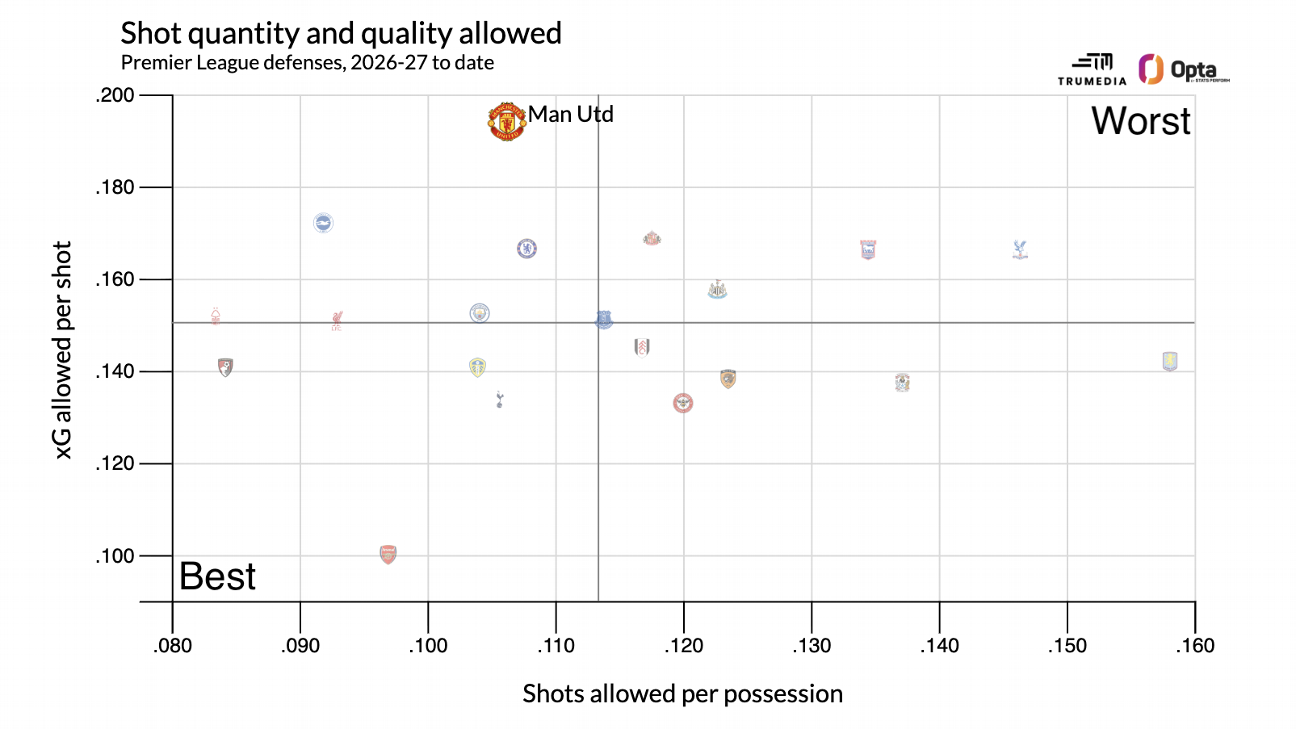
United rank ninth in shots allowed per possession, roughly in line with what Chelsea and Tottenham Hotspur are allowing. But opponents are averaging 0.19 xG per shot, by far the most in the league and equal to what Manchester City's Erling Haaland is averaging in Premier League play this season. Basically turning every opposing forward into Haaland seems like a pretty bad way of winning matches. Opponents have attempted 74.6% of their shots in the box (most in the league), and United defenders have blocked only 22.0% of opponents' efforts (second fewest).
In essence, United are suffering the worst parts of a heavy-possession style (breakdowns in transition) without some of the benefits. They're decent in the possession game (sixth-highest possession rate, fourth-most passes per possession), and thanks to solid ball progressors such as Bruno Fernandes and Youri Tielemans, they're second in the league in progressive passes and third in progressive carries. But their pressing game itself isn't very aggressive or effective -- they're only eighth in high turnovers created (9.6 per game) and 10th in passes allowed per defensive action (12.4) -- and they're therefore struggling to turn ball progression into actual opportunities against parked defenses. While they rank second in the league in shot attempts per possession, only 54.9% of those shots came from inside the box (worst in the league), and they rank 14th in xG per shot (0.14).
Man United's finishing has been substandard, too. Outside of Fernandes and Bryan Mbeumo, United players have scored just five goals from shots worth 9.4 xG in league play (Matheus Cunha, Marcus Rashford and Amad Diallo have one goal from 3.3 xG).
So ... you have a situation in which United dominate opponents in terms of shot quantity, but opponents take all the good and accurate shots. United are actually excellent in quick-attack situations, ranking second in counterattacking shots per game and first in xG margin from counterattacks, but they don't seem to know what type of team they want to be. They've also allowed six set piece goals (18th) and scored only one (15th).
Nothing is stylistically cohesive here, but then again, how could it be?
The Man United squad Pochettino is inheriting
It's tricky to even lay out the lineup that Pochettino inherits, since because of a combination of injuries and unsatisfying options, Diogo Dalot has played the most minutes at both right back and left back thus far, and Bryan Mbeumo has played the most minutes both at center forward and on the right wing.
But based on this season's minutes, we can loosely say this is what Manchester United's squad has looked like this season:
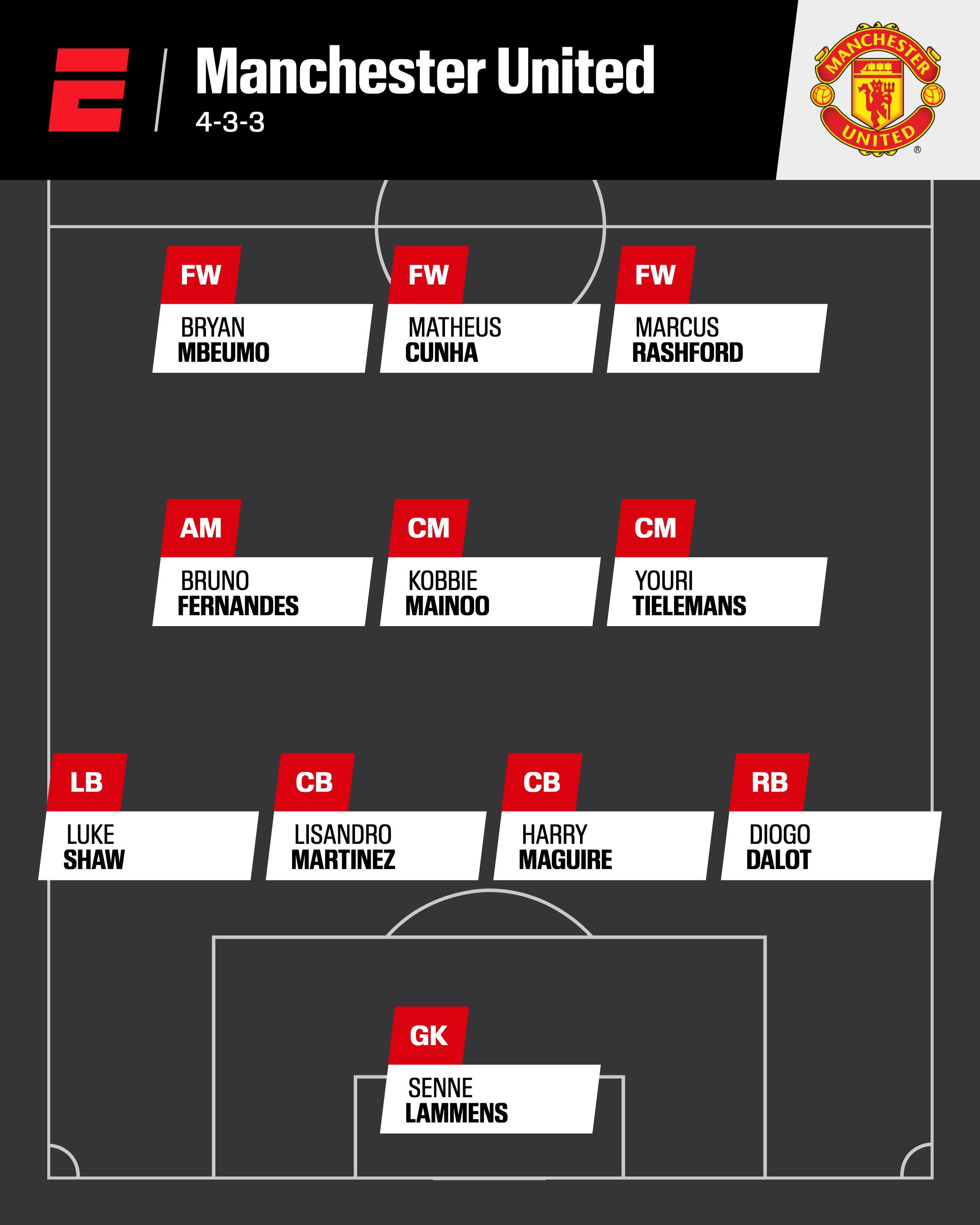
Most-used bench players: defenders Leny Yoro (20) and Ayden Heaven (20), midfielder Andrey Santos (22) and forward Amad Diallo (24)
That's 15 players -- two acquired (or making their debut) during the van Gaal era, one from Mourinho's, three from Solskjaer's, three from ten Hag's, four from Amorim's and two from Carrick's. Six (Shaw, Martinez, Maguire, Tielemans, Fernandes, Rashford) are 28 or older, and only two (Mainoo, Lammens) of the starters, plus all four primary bench players, are 24 or younger.
What might be most telling here is who I didn't list at all. Due to both injury and general poor fit, defender Matthijs de Ligt (27), midfielders Mason Mount (27), Manuel Ugarte (25) and Carlos Baleba (22), and attackers Joshua Zirkzee (25) and Benjamin Sesko (23) have commanded just 1,268 total minutes in all competitions this season (211.3 per player) despite having commanded a combined transfer fee of €357.6 million and, per FBref.com, combined estimated annual salaries of €58.7 million per year.
For all the justifiable complaints about the debt the Glazers foisted on the club or the cost-cutting measures instituted by Ineos as new controlling owners, United's biggest problem since Ferguson left isn't that they haven't spent enough money -- it's that they've spent foolishly and haven't gotten nearly enough return on their (foolish) investments. They'll spend too much for players at or past their peaks, and then they'll invest heavily in a younger player while giving him no semblance of a healthy developmental environment. When you have the fourth-highest estimated payroll in the league and you're 18th in the table, the latter's a far bigger problem than the former.
Pochettino's biggest challenge at Man United
Pochettino has held many high-profile jobs through the years; most recently, he spent a season-and-a-half at Paris Saint-Germain, a season at Chelsea and most of a World Cup cycle with the U.S. men's national team. But he primarily is being hired because of his work at Tottenham Hotspur, where he took on a club in transition and refreshed the squad with younger players but still managed to improve its Premier League performance from 68.4 points per season over the five years before his arrival to 73.6 in his first five seasons on the job. Spurs also reached five semifinals (and one final) in domestic competitions and the finals of the 2018-19 Champions League.
With the USMNT, maybe Pochettino's greatest accomplishment was figuring out how to maximize his team's athleticism advantages while also unearthing and unlocking the potential of younger players such as Malik Tillman and, especially, Alex Freeman. The U.S. ran lesser teams into the ground at the 2026 World Cup, though its round-of-16 loss to Belgium hit a lot of the same notes as its 2022 World Cup loss to the Netherlands under Gregg Berhalter -- once matched up against a seasoned and smart Western European team, the Americans' merely decent tactics and talent caught up to them.
Still, you can understand the vision of hiring someone like Pochettino. His style of play could quickly earn him fan support, and nothing would benefit Manchester United more than unlocking a young roster core and, perhaps, unearthing more young talent from the club's academy.
Only that core needs some work. The club is spending a mountain of money on older and/or ineffective players who are, in some cases, signed to long-term deals: Rashford, Maguire and Mount are signed through 2028, Dalot through 2029, de Ligt, Ugarte and Zirkzee through 2030, and Tielemans through 2031. But beyond that, the core of 24-and-under players just isn't that impressive compared with United's richer peers.
United's top six 24-and-under players, per the player valuations at Transfermarkt, are Sesko, Mainoo, Baleba, Diallo, Yoro and Lammens. Their combined value is €340 million, and that's with what feels like an extremely questionable €75 million valuation for Sesko. Among the 10 richest clubs per the most recent Deloitte Money League data, this core is more valuable than those of only Arsenal and Pochettino's former club, Tottenham Hotspur. Arsenal are very much in a win-now cycle -- and unlike United, are actually winning now -- which means that among United's peers, their roster core might be better than only the one at Spurs.
Pochettino's task will be to get his younger players back on a proper developmental track, and with a little bit of injury luck, it's not hard to see him finding reasonable success, especially with Mainoo, Santos and Baleba in the midfield. And even if he can't pull a coup and change 16-year-old starlet JJ Gabriel's desire to leave and potentially join Real Madrid, Pochettino could still potentially create a strong foundation for young players including not only Yoro and Heaven, but also teenagers such as defenders Harry Amass (19) and Godwill Kukonki (18); midfielders Jim Thwaites (18), Jacob Devaney (19 and currently on loan), Tyler Fletcher (19) and Jack Fletcher (19); and attackers Shea Lacey (19), Tynan Thompson (18) and Chido Obi (18 and on loan).
Plenty of managers have seen short-term success at United, however. Longer-term success will require a high level of coordination and cohesion between manager and front office. That's something United hasn't proved capable of generating at any point in recent history, and it's something that Pochettino didn't find at Chelsea.
Carrick was fired almost 40 years to the day that United hired Ferguson in 1986; that was also the last season in which United found themselves 18th in the table after 10 matches. It took Ferguson more than three years to fully establish himself in the job; United haven't had a guy who lasted three years since Ferguson retired.
We know how successful soccer clubs are supposed to operate, and we know that Manchester United have been nowhere close to that path of late. It's entirely conceivable that with his experience, strong man management and powerful personality, Pochettino will turn out to be the guy who finally unlocks United's potential again. But after nearly 15 seasons of inconceivable listlessness, the club itself bears all the burden of proof.