

As you might already know, this is going to be the first Premier League season that won't feature Sir Alex Ferguson, Arsene Wenger, Jurgen Klopp or Pep Guardiola on the touchline -- the first season without at least one of its four history-rewriting, league-defining managers.
Coming off of a World Cup cycle, we're entering into a new, unknown era.
Clubs are still happy to let the manager take all of the blame even though they have increasingly marginalized the role of the "manager." Only one current manager has won the Premier League before, and it's the guy who did it only a couple of months ago: Arsenal's Mikel Arteta. The role, increasingly demoted to "head coach," doesn't have the same influence it once did.
A shift isn't only happening on the sideline. One is also happening on the field. The defining player of the league's past decade, Liverpool star Mohamed Salah, has moved to Trabzonspor in Türkiye. He won the PFA Player of the Year award three times over the past 10 seasons -- the same number of POTY trophies that the pool of active Premier League players can claim.
One of those went to Liverpool defender Virgil van Dijk, who turned 35 over the summer. Another went to Phil Foden, who hasn't been able to hold down a starting spot in Manchester City's lineup over the past two seasons. The third, of course, went to this summer's World Cup star, Erling Haaland of Man City.
But beyond Haaland, who are the defining players in the world's richest and most competitive league? At the end of the month, Manchester United midfielder Bruno Fernandes is likely to win the POTY award for last season, but he turns 32 in September. And the league's best team, Arsenal, were so nonreliant on any one player that we spent most of the season screaming about their set pieces.
Ahead of what seems likely to be a question-answering and uncertainty-settling 2026-27 season, let's take stock of the player pool. ESPN's Premier League Top 50 is back for another year.

How the rankings work
We've been doing the Premier League Top 50 for the past two seasons, and we're changing this one up.
Rather than a straight 50-to-1 ranking, this top 50 will be divided up into seven tiers. In a sport in which it's so hard to define what "best" actually means beyond "guy who scores and assists the most goals," the tiers better align with how soccer actually works and how we might think of player value.
Almost every team in the league has a couple of players everything hinges upon: midfielders who carry the ball-progression load, defenders who allow the team to play a certain style, attackers whom everything gets funneled through. But a player who can carry Crystal Palace's attack is only as valuable to, say, Manchester City if he's also able to carry a title-winning attack. There are, what, 10 players in the world good enough to do that?
Looking at it the other way: A rangy passer who can cover multiple different positions along the back line might be less valuable to Palace than the aforementioned attacker, but he might be more valuable to City, who need players to fill in the gaps behind their world-class attackers.
The tiers, as you'll see, help to get around this problem.
As for who is eligible for this list: anyone currently in the Premier League and expected to play at some point over the next couple of months.
As for players we haven't seen in the Premier League yet, we'll take a conservative and an aggressive view at the same time. The level of competition is so much higher, top to bottom, than in any other league that no new players to the league have landed in this top 50. But if someone such as Aston Villa's Johan Manzambi is great over the first month of the year, he could shoot up the next edition of the rankings because he'll have, essentially, proved he translates to the league.
Let's get to the ranking.

Tier 7: The best prospect in the league
50. Estêvão, attacking midfielder, Chelsea
Is Estêvão really the 50th-best player in the league? Well, if we look at the ratings from the stats app Futi, he was even better than that last season.
Futi's model rates players based on how much every touch they take with the ball increases their team's chances of scoring and decreases its chances of conceding. The model then layers in regularized adjusted plus-minus, which is a complex way of replicating the on-off stats you might see in basketball, by controlling for teammate quality, opponent difficulty and a number of other factors. This helps to pick up on players who are doing things without the ball that help their team win.
Then, the model controls for playing time and outfield position, and normalizes the numbers on a 1-99 scale where 50 represents the average Premier League player. As an 18-year-old for Chelsea last season, Estêvão rated a 67 -- the 37th-best mark in the league.
Like most young attackers, he's providing the most value with his ball-carrying, but he's also above average for everything else Futi tracks: shooting, creating, buildup play, receiving passes and winning the ball.
Again, he did this as an 18-year-old in the toughest league in the world -- and for a team that finished in 10th place. He played only 900-plus minutes and is coming off of a severe hamstring tear, but is already on the future superstar track. I can't wait to see what happens this season.
Tier 6: The three goalkeepers
49. Bart Verbruggen, goalkeeper, Brighton
48. David Raya, goalkeeper, Arsenal
47. Emiliano Martínez, goalkeeper, Aston Villa
Are goalkeepers the attackers of defenders?
No, that is not a typo. When you break soccer down to its component parts, you quickly realize that even though attackers don't touch the ball as often as everyone else, they have the biggest impact on whether possessions turn into goals. And because goals win games, they're the most valuable players on the field. Transfer fees and salaries suggest that clubs around the world agree.
But if that's true, could we say the same about goalkeepers? They, too, barely touch the ball, but almost by definition, most of their touches are the most important any player can take: the ones that determine whether a goal is scored.
I'm certainly open to the idea that goalkeepers are way more valuable than we think. Unfortunately, their performance is hard to measure in any predictive way. When you look at goals allowed compared with what a model expects, you still tend to see large flips from season to season. That's because any mistake -- an easy save that goes in -- gets punished so harshly in that type of rating system and because keepers don't get to control what shots they face.
Instead, keepers tend to be the lowest-paid players on the field, so I'm going to put them in their own tier for now and hold it toward the bottom of the rankings.
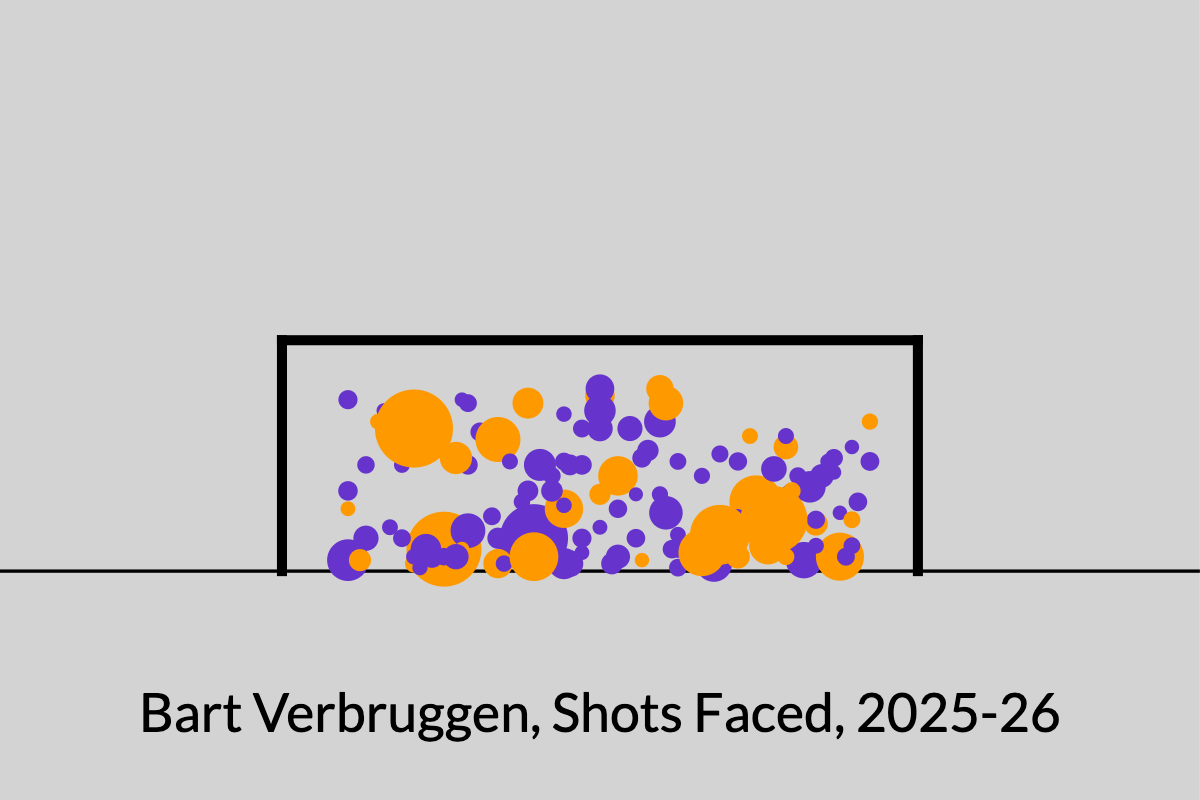
As for the three keepers we've included: Verbruggen was great at everything last season, and at just 23, he looks as if he might be the world's next star keeper. But last year was his first elite shot-stopping season.
Goals are orange, saves are purple, and the larger the circle, the higher the xG (expected goals value) of the shot:
Raya, meanwhile, never really grades out well by the shot-stopping metrics. But there's enough uncertainty around these numbers and how they're produced that I'll allow myself to trust my gut. Raya just feels like a really good keeper. He's always making big saves, and he's hard to quantify because Arsenal give up so few quality shots. He's a fantastic sweeper-keeper, and is great with his feet.
Martínez, meanwhile, has conceded fewer goals than expected in each of the past four seasons. You don't need me to tell you he's good. You watched the World Cup.
Tier 5: The best players on mid-to-upper-table teams
46. Daniel Muñoz, wingback, Crystal Palace
45. Amad Diallo, winger/wingback, Manchester United
44. Sandro Tonali, midfielder, Tottenham
43. Igor Thiago, striker, Brentford
42. Ezri Konsa, center back, Aston Villa
41. Eberechi Eze, attacking midfielder, Arsenal
40. Morgan Rogers, attacking midfielder, Chelsea
39. Pedro Neto, winger, Chelsea
38. Matheus Cunha, attacking midfielder, Manchester United
37. Bryan Mbeumo, forward, Manchester United
36. Jan Paul van Hecke, center back, Tottenham
35. Marcos Senesi, center back, Tottenham
34. Adam Wharton, midfielder, Crystal Palace
33. Elliot Anderson, midfielder, Manchester City
This tier is reserved for players who have flourished being the main guy on sub-elite teams; guys who have been great playing in a system that no big team would ever play, or those who have moved to bigger clubs and contributed but haven't helped push them into title contention.
First, the players who didn't change teams this summer:
Muñoz is a world-class athlete who started to create chances around the opposition goal last season.
Amad has been very good for two seasons in a row -- let's see how he does for a United team that actually have expectations.
Thiago was immediately one of the best goal scorers in the league for Brentford, but would he move the needle for a Champions League club?
Konsa has been solid and dependable for Villa. Can he make the jump to a team like Arsenal?
Outside of going off twice against Tottenham, Eze had a disappointing first season in North London.
Neto has been better for Chelsea than I expected, but the goal and assist production just hasn't been what you need for a winger on a team aiming to win the league.
Cunha and Mbeumo made United competent again. Can they take them further than that?
Wharton is already one of the best creative passers from midfield in the world, and he's only 22, but I'm not sure how many big clubs could stomach how aggressive he is on the ball. I can't remember the last midfielder who played for a top team and completed fewer than 80% of his passes the way Wharton did last season.
Now for two of the biggest movers this summer: Tonali (£92.5 million) and Rogers (£117 million).
The fees paid suggest their new clubs see them as, or at least expect them to be, among the best players at their positions in the world. Per Futi, Tonali ranked in the 53rd percentile for value added in the Premier League last season, and Rogers was down in the 48th. Tonali is already 26 and isn't likely to improve.
The two new Tottenham center backs, Van Hecke and Senesi, were arguably the two best passing center backs in the league last season.
Senesi, per Futi, led the league in progressive passes. These are all of his progressive passes and carries for Bournemouth:
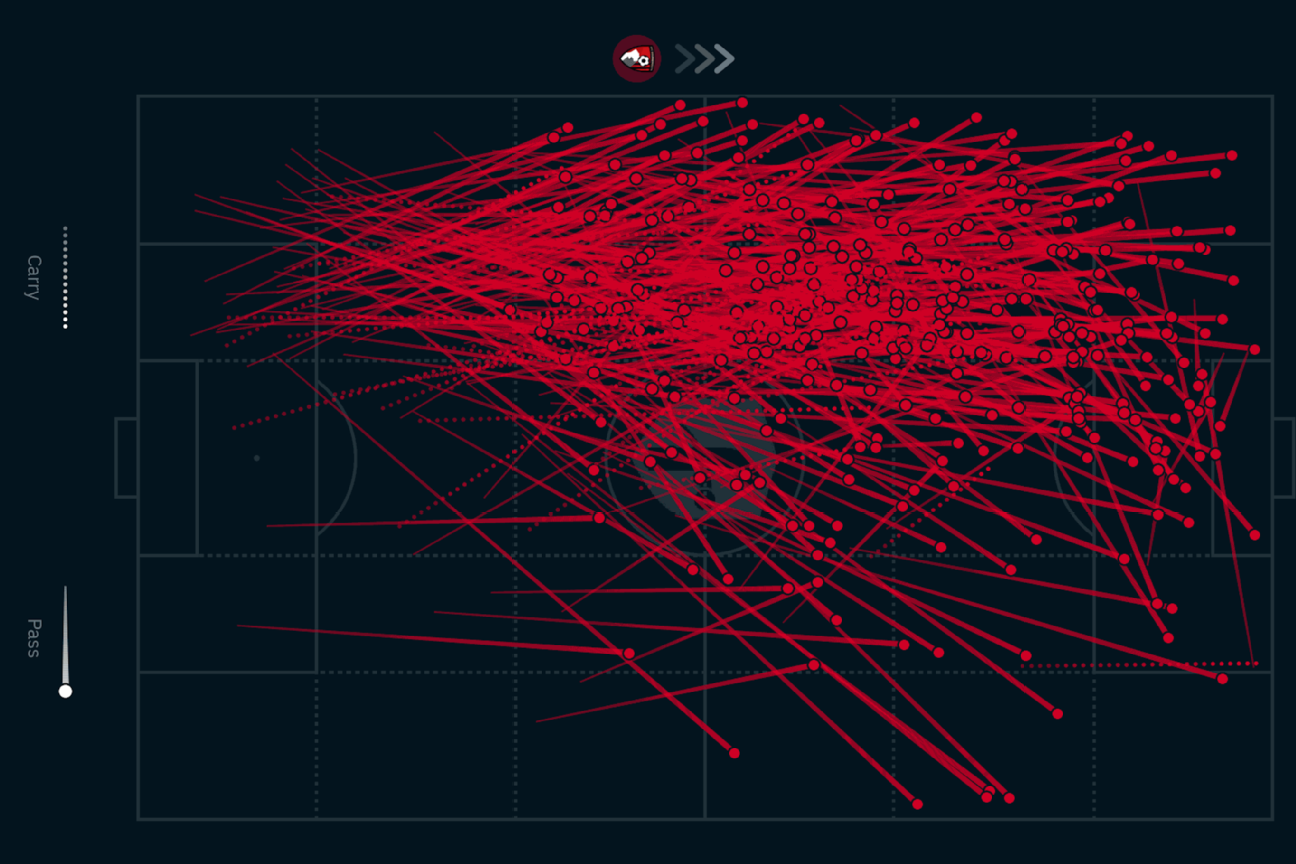
Spurs need that passing badly -- the question for both players is a seemingly odd one for a defender: Can they defend?
And then there's Anderson, who I suspect will move up these rankings as the season progresses.
Last season with Nottingham Forest, Anderson was the rare midfielder who won the ball a ton, constantly moved play up the field and dominated possession. He took a higher share of his team's touches (15%) than any other midfielder in the league last season. It's rare to see a player do this on a team in the bottom half of the table; it's rarer still to see a 23-year-old being the one who does it.
If anything, Anderson's production might increase now he has moved to a team (Manchester City, £116 million) that has more possession and much better teammates to receive his passes. But he's stuck in this tier until we actually see it.
Tier 4: Starter on a title-winner
32. Cody Gakpo, forward, Liverpool
31. Youri Tielemans, midfielder, Manchester United
30. Nico O'Reilly, fullback, Manchester City
29. Alexis Mac Allister, midfielder, Liverpool
28. Ryan Gravenberch, midfielder, Liverpool
27. Martín Zubimendi, midfielder, Arsenal
26. João Pedro, forward, Chelsea
25. Kai Havertz, forward, Arsenal
24. Marc Guéhi, center back, Manchester City
23. Reece James, fullback, Chelsea
22. Antoine Semenyo, forward, Manchester City
21. Rúben Dias, center back, Manchester City
This is the most boring section of the list: a bunch of unspectacular players and a handful of guys rival fans or even their own don't actually think are all that good. But you don't win titles without players like this all over your starting XI.
The first three forwards will never lead their club in goals+assists, but they move so well without the ball and do a bunch of other little things that they make life easier for their teammates. They still, of course, need world-class teammates to fully realize their value.
Semenyo, meanwhile, was on a finishing heater last season -- 17 goals from about 11 expected -- but Man City were the best team in the league after he joined midway through the campaign.
The midfielders in this tier are all either above average but not elite with and without the ball like Zubimendi or Mac Allister, or, like Gravenberch with ball-carrying and Tielemans with passing, have one particularly elite skill and need others to cover for their deficiencies.
James and O'Reilly are the kind of fullback/midfield hybrids who allow teams to dominate possession in a way that puts them less at risk of getting countered up the gut. And Dias and Guéhi are good all-around center backs but without the kind of out-of-this-world abilities you need if you're going to be the best player -- or close to it -- on a title-winner.
Tier 3: Let's see which way they go
20. Florian Wirtz, attacking midfielder, Liverpool
19. Alexander Isak, forward, Liverpool
18. Cole Palmer, attacking midfielder, Chelsea
17. Enzo Fernández, midfielder, Chelsea
16. Virgil van Dijk, center back, Liverpool
15. Martin Ødegaard, attacking midfielder, Arsenal
14. Rodri, midfielder, Manchester City
Pretty much anyone in this section could be way lower, way higher, or out of the league by the next time we do this.
Wirtz and Isak had disappointing debut seasons with Liverpool. Isak sat out the preseason and then broke his ankle midway through the season. Wirtz seemed the perfect player to add to Liverpool's title-winning team -- an immediate upgrade and a bridge to the next generation -- but he spent most of the season as a secondary player: someone who could help move the ball up the field or create chances but not the one Liverpool relied on to do it. They both should be a lot better this season.
The same goes for Palmer, who was one of the 10 or so best players in the league until last season, when he struggled through injuries and the general chaos at Chelsea. He's just entering his prime and I expect a big bounce-back season coming up.
I'm sort of confused about what kind of player Fernández actually is or even should be. He came to Chelsea as what I basically described Anderson as earlier: a deep-lying midfielder who could win possession often enough and progress the ball up the field at an elite rate. That's what he was in his first half a season with the Blues, and since then ... he has been a box-crashing midfielder who scores a bunch of goals?
Van Dijk falls prey to his previous standard of unmatched excellence and the lack of protection around him at Liverpool. He's not the player you can build your approach around anymore, someone who lets you play as aggressively as you can -- both in how the team play and the players who get selected -- because he will clean up any mess. But he's still a very good defender and a really great passer.
Ødegaard probably would've been in the first tier a couple of weeks ago -- or at least the second -- but then Arsenal signed a player (Bruno Guimarães) who might replace him? We'll see how Mikel Arteta's first-choice midfield shakes out over the first month or so and then reassess.
And Rodri might not even be in the Premier League next time we do this. But for now, he belongs in the tier of uncertainty. Despite a fantastic World Cup, he wasn't fully back to speed in the Premier League last season. The summer makes you hopeful that he might get back to where he was before his knee injury, but the Premier League (or LaLiga) is a much higher and much more demanding level of play than what we saw at the World Cup.
Tier 2: The supporting star on a title-winner
13. Jurriën Timber, fullback, Arsenal
12. Dominik Szoboszlai, midfielder, Liverpool
11. Josko Gvardiol, defender, Manchester City
10. Bruno Guimarães, midfielder, Arsenal
9. Moisés Caicedo, midfielder, Chelsea
8. Jérémy Doku, winger, Manchester City
7. Rayan Cherki, attacking midfielder, Manchester City
This tier is filled with two types of players: genuinely excellent two-way players, and world-class attackers who haven't had to be the No. 1 guy on one of the best teams in the world.
In the first group, Timber was really limited in possession when he first came to Arsenal. Then, when he was healthy last season, he was maybe the best attacking fullback in the Premier League. And that's on top of being maybe the best one-on-one defending fullback ... in the world. The big question going forward: Can he stay healthy for a full season?
Szoboszlai is the ultimate utility player: He does a little bit of everything and fills all of the gaps. It feels weird to say it about a player who has so many flashy moments, but he's at his most valuable when he's doing what he did in his first few years with Liverpool. You know, charging up and down the field, making runs, pressing and filling spaces -- all the stuff that allowed Mohamed Salah and Trent Alexander-Arnold to do what they did.
Am I irrationally high on Gvardiol? Yes. But he's only 24, and he's already the most versatile defender in the world.
The only reason Guimarães and Caicedo aren't higher are the tiny deficiencies in both of their games. The former needs more defensive cover than he used to, and the latter can't quite dominate the game on the ball in the same way, say, Rodri or PSG's Vitinha might. Otherwise, they both do pretty much everything you could want from a midfielder.
As for Doku and Cherki, you've got the best ball carrier in the Premier League and perhaps the best passer. Per Futi, Doku completed 238 progressive carries last season; second place had 151. And Doku did it in only 1,900 minutes. Cherki, meanwhile, was Futi's highest-rated player in the league at 87 out of 100. He, too, didn't break the 2,000-minute mark.
Though we might expect a decline in City's performance after Guardiola's departure, there's one easy way for new manager Enzo Maresca to make the team better: make sure these two guys are on the field more often.
Tier 1: The best player on a title-winner
6. Gabriel Magalhães, center back, Arsenal
5. William Saliba, center back, Arsenal
4. Bukayo Saka, winger, Arsenal
3. Declan Rice, midfielder, Arsenal
2. Bruno Fernandes, attacking midfielder, Manchester United
1. Erling Haaland, forward, Manchester City
In case you're still wary of the idea of a possession-value model, such as Futi's telling us anything about the sport that actually resembles reality, these six finished the 2025-26 season inside the model's top 12 players.
Between Gabriel and Saliba, the latter is the better and more impactful defender. There are so many threatening-looking opposition attacks that reach Saliba's area of the field and then slowly fizzle. He's the best center back in the world.
It will be really interesting to see how Arsenal perform without the injured Saliba in the lineup for the first few months of the season. He's also the ideal partner for a player such as Gabriel, who prefers to be much more aggressive out of possession. But the Brazilian makes it into the top tier because he's the most dangerous set-piece player for the greatest set-piece team the league has ever seen.
Last season, Saka had a down year in goals and assists, but he might have the highest floor of any top attacker in the world. Even if he's not creating chances or scoring goals, he's still putting in a ton of defensive work, driving the ball up field in possession and drawing the attention of the opposition defensive shape.
His teammate Rice is the only midfielder in England, and perhaps the world, who is good at everything. Winning possession, covering space, 50-50 balls in the air, carrying the ball, progressing play, creating chances, scoring goals, making runs? He does it all at least an above-average level. Bonus points, too, for his consistently excellent set-piece delivery.
Rice and Saka dealt with injuries all summer, and I'm not sure even a team with Arsenal's depth can afford to deal with Saliba, Saka and Rice all below full strength.
And then at No. 2: Fernandes, who just set the single-season assist record.
That leaves Haaland at No. 1: Over the past eight seasons, he has scored the second-most goals among all Premier League players -- and he has been in the league for only four years.