

You can picture it, right?
After his Paris Saint-Germain side win a second straight UEFA Champions League title later this month, manager Luis Enrique saunters up to the microphone. His team have just defeated Arsenal 3-1 in the final in Budapest, Hungary. They have now won eight straight games against Premier League competition. And over their last 12 games against English sides, their only two losses came in two-legged ties that they ultimately won.
Looking, as he always does, like a dad who decided to get really into cycling, the wiry Enrique decides to take a victory lap against the so-called greatest league in the world.
"You in England are playing the style we Continentals used so many years ago," he says. "With much physical strength, but no method, no technique."
You're probably nodding along because this is all you've been hearing since the first legs of this year's two Champions League semifinals -- a nine-goal thriller between Bayern Munich and PSG, and 1-1 draw between Arsenal and Atlético Madrid where both goals came from the penalty spot. It's a hypothetical quote, but this sure seems like where things are headed, doesn't it?
Except, it's actually not a made-up quote. No, a manager did once say those exact words -- back in 1960.
Helenio Herrera's Barcelona had just beaten the defending English champions, Wolverhampton Wanderers, 5-2 in England to clinch a 9-2 aggregate victory in the quarterfinals of the European Cup. On his way back home, Herrera decided to hold an unplanned news conference in the Birmingham airport in order to mock the people who claimed they invented the sport: "When it came to modern football, the Britons missed the evolution," he added.
The idea that the physicality of English soccer leaves its teams ill-equipped to compete with their more daring and technical counterparts in Europe has been around since the mid-1950s, when these teams first started competing against each other.
It bubbles up every 10 years or so, and you're hearing it again today: that the Premier League is too physical for teams to peak at the right time, that its sides could never play like Bayern Munich and Paris Saint-Germain, and that the way those non-English teams play is the way the game should be played.
If this idea were true, though, then how would we explain that English sides have won 15 European trophies -- second-most of any country? Or, more recently, that eight of the past 16 Champions League finalists came from the Premier League? The answer, of course, is that a handful of knockout matches in a given year doesn't really tell us anything meaningful about the state of European soccer.
- USMNT depth chart: Top 15 players in each position, ranked
- What if Liverpool didn't sign Salah? An alternative history
- Ranked: Top 20 women's soccer club managers in the world
Why Premier League teams can attack, even with all of the extra games
We all loved the first leg of Bayern-PSG -- even Arsenal manager Mikel Arteta did.
"Bayern-PSG is probably the best game I have ever witnessed on the quality of two teams, and especially the individual quality that the players deliver," he said. "I've never seen something like this. But when I look at the amount of minutes and the freshness of those players, then I'm not surprised.
"To deliver those moments of quality, you have to be very fresh, and the difference in the leagues and the way they compete is night and day, and you just have to see a lot of stats that have been recently around it."
He's right -- about the stats. Just take a look at the 10 players with the most minutes played across all competitions among the four teams in the Champions League semifinals:
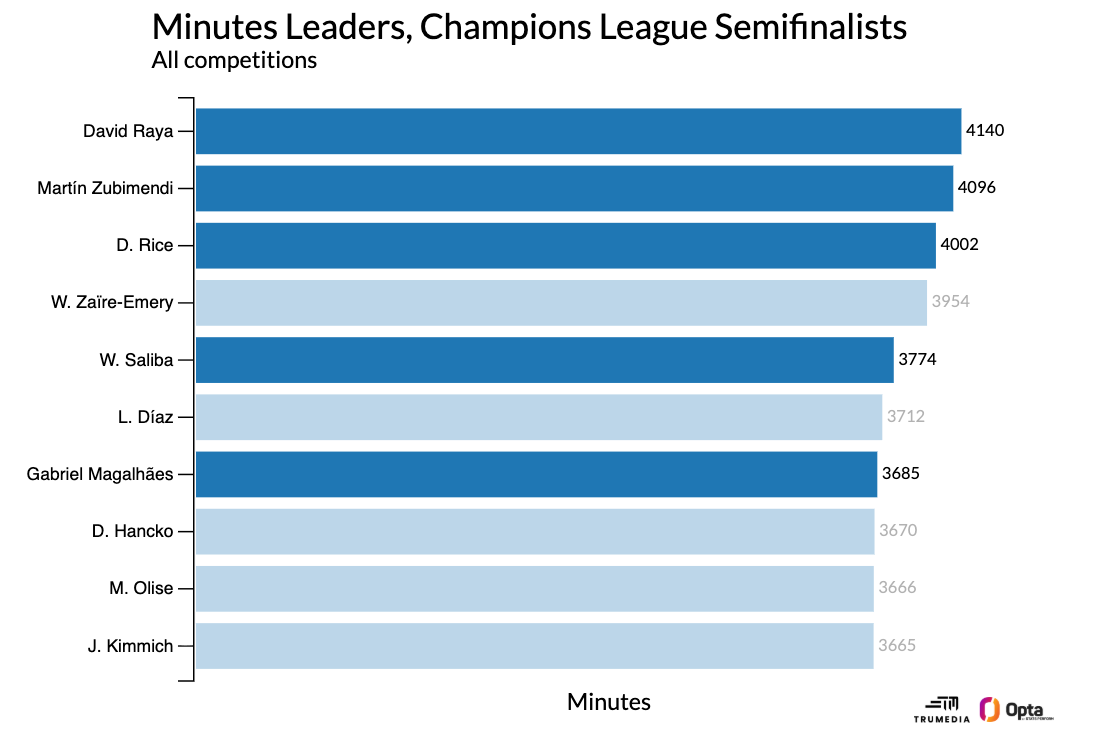
I've highlighted all of the Arsenal players. And yes, they comprise half of the top 10, while Bayern have three, and Atletico and PSG both have one.
To emphasize the difference between playing in the Premier League and playing in Ligue 1, Gradient Sports looked at the physical output of Arsenal and PSG's two box-to-box midfielders: Declan Rice and João Neves. Here's how they described it:
● The Minutes Gap: Neves would need to play nearly 22 consecutive 90-minute matches just to reach Rice's time on the pitch.
● The Distance Gap: To catch Rice's 350.34 km, Neves would need to run almost five full marathons.
● The Acceleration Gap: Rice has accelerated almost 900 more times than Neves over the course of the campaign.
That's a massive difference, but it's not necessarily anything new.
If we go back four years and compare the minutes for Bayern and PSG to the two English clubs who made the Champions League semifinals that year, it's the same -- if not more extreme. The chart cuts the minutes off at the beginning of May because neither Bayern nor PSG made the semifinals that season:
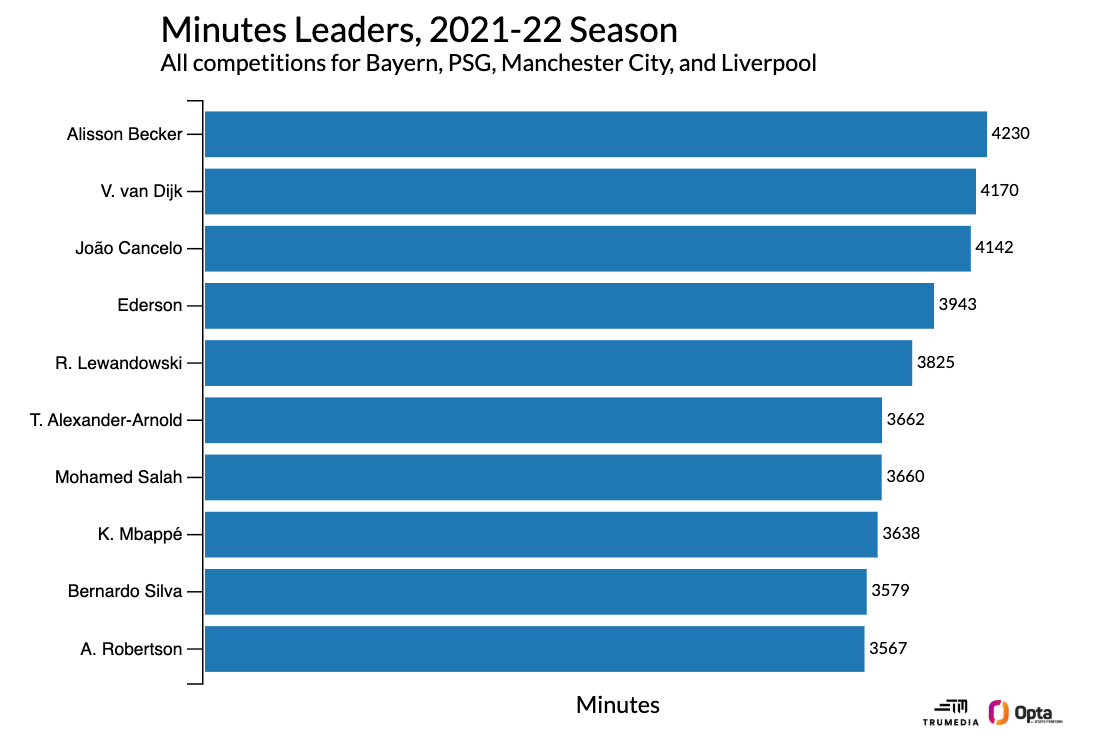
That's five Liverpool players and three Manchester City players.
I only have access to domestic-league physical data for the 2021-22 season from Gradient, but among these four clubs, the top 10 in total distance covered included three Man City players (Rodri, Bernardo Silva, and João Cancelo) and four from Liverpool (Sadio Mané, Jordan Henderson, Trent Alexander-Arnold, and Virgil van Dijk). And then there were two City players (Cancelo and Aymeric Laporte) and six from Liverpool (Van Dijk, Alexander-Arnold, Mané, Andy Robertson, Mohamed Salah, and Joel Matip) in the top 10 for total accelerations.
Those players all played under similarly extreme physical demands to Arteta's Arsenal -- and both sides did it while playing daring, attacking, and high-pressing styles that we saw from PSG and Bayern last week. That season, Manchester City and Liverpool's possessions started higher up the field than any other teams in Europe's top five leagues, and they were the only two clubs in Europe to attempt more than 700 shots over the course of the season.
They both won 90-plus points in the Premier League, and although they both suffered improbable losses to Real Madrid in the Champions League, they were the two best teams in Europe from start to finish.
Meanwhile, back then, PSG and Bayern both strolled to domestic titles, but the former were bounced in the round of 16 after capitulating in the second leg of their matchup against Real Madrid, while the latter couldn't get past Unai Emery's Villarreal in the quarterfinals. Up until last season, the narrative that had developed around both clubs was that their domestic dominance was harming them in Europe.
Every year, neither side would play a legitimately competitive, high-pressure match until they reached the Champions League knockout rounds. Unlike the best teams in Spain and England, Bayern and PSG never faced opponents who could match their level of talent, who could prevent them from dominating the ball, or who could consistently punish their over-aggressiveness. The solution to every match was simple: attack, and then keep attacking.
The exact opposite, of course, is now supposedly true: that easy domestic seasons are allowing both clubs to peak at the right time, be aggressive, and dominate the ball.
But the reality is that neither idea is quite right.
So what can we say about the state of European soccer?
Just a couple of months ago, the Premier League was dominating the Champions League, with five English teams earning eight of the automatic places for the round of 16. They were then joined by Newcastle United to give them six of the 16 sides in the playoff stage -- double the country with the next-most teams.
Of course, only one is left, but the advantage the Premier League has over everyone else doesn't appear at the absolute top. It appears in how two teams in the bottom half of the table this season still reached the knockout rounds of the Champions League. From a fundamental financial perspective, teams like Arsenal, Manchester City, and Liverpool are on roughly equal footing with the likes of PSG, Bayern Munich, Barcelona, and Real Madrid. Estimates of overall talent and wage bills back that up.
So, what happens when these teams meet each other in the Champions League is determined mostly by the randomness of the bounce of the ball and then the specific quirks of each individual team at that moment in time, rather than any leaguewide identity or context.
Bayern built a win-now team -- with an average age weighted by minutes played of 28.2, same as Everton -- that have arguably the best striker in the world, arguably the best player in the world, and arguably best tertiary attacker in the world. Vincent Kompany has smartly leaned into his team's offensive firepower, but the main story here is that this team have Harry Kane, Michael Olise, and Luis Díaz.
Kane is able to score a ton of goals and facilitate all of the team's other talented attackers; Olise can create chances for himself and for his teammates, and he's able to get on the end of chances; while Diaz is the ideal foil for that pairing: unceasing pressing and off-ball running, but also able to beat defenders off the dribble when he has to.
The story with PSG is less that they don't have to tax themselves domestically and more that they've finally committed their near-unlimited wealth to a cohesive idea: pressing high. You can't do that with aging superstars, so they've built a team of athletic peak- and pre-peak-age players who can all do the things that Luis Enrique asks of them.
But PSG are also on a red-hot run of likely unsustainable execution in front of goal. Through their five knockout-round matches so far, they have scored 17 goals and conceded six. But that comes from just 7.38 expected goals (xG) created and 8.03 xG allowed, which adds up to a negative xG difference over the games against Chelsea, Liverpool, and Bayern.
A devotion to pressing, passing, and possessing has all been way less important than PSG's ability to get a limited number of quality attempts past the opposing goalkeeper.
The teams in the Premier League, meanwhile, are all in various degrees of mess. Both Newcastle and Tottenham are in the middle of horrible domestic campaigns; Chelsea are on their third manager of the season already; Liverpool are fighting through the stops-and-starts of overhauling their title-winning squad. City only really seemed to figure out the best version of themselves a month or two ago; and most of Arsenal's best attackers have been injured.
This all isn't to say that the increased number of matches -- and genuine competitiveness of all of those matches -- doesn't hurt Premier League teams in some way. And the rest of the Premier League is better than it's ever been this season. But the main way that evinces itself is not in how the teams are able to play, but with who is healthy enough to be on the field.
Against Atlético Madrid in the semifinal first leg, Arsenal's starting XI was without Bukayo Saka, Kai Havertz, Riccardo Calafiori, and Jurriën Timber, while Martin Odegaard was only fit enough to play less than an hour. Against PSG, Hugo Ekitike and Alexander Isak both started the quarterfinal second leg for Liverpool -- and neither one even made it to the second half.
Now, the Premier League has entered into a weird kind of tactical stalemate -- where set pieces dominate goal scoring and slower ball-control characterizes the preferred styles of the richest teams. But that was also true earlier this season, when Chelsea were beating Barcelona, Liverpool and City were taking down Real Madrid, and Arsenal were breezing past Bayern Munich.
Just last year, Arsenal thumped Madrid in the quarterfinals, and Liverpool lost to PSG on penalties. And just two seasons ago, Jurgen Klopp's Liverpool went heavy metal and still ripped off an 82-point season -- the same pace that both Man City and Arsenal are currently on.
It's not true that Arsenal don't play like Bayern and PSG because they play too many games. It's because Arsenal haven't built a roster that should ever try to play like Bayern or PSG. You don't keep converting center backs into full backs if you're comfortable ever playing in a nine-goal game.
Thanks to their domestic dominance, financially and competitively, Bayern Munich and PSG are able to build deep squads and then rotate through those players. Premier League teams, meanwhile, simply play more games and face a much stiffer level of competition, week in and week out.
That's all true. It's just that, well, it's always been true -- regardless of who's winning in the Champions League.